This is a sharing platform where volunteers trying to teach can share their teaching methods, resources, tips&tricks.

If you are a volunteer trying to teach, feel free to be inspired and find useful information.
If you want to share, feel free to contact me:
elena.ziegler.ruiz@googlemail.com

I did my volunteer service August 2014-2015 in Malawi.
I was part of the German government program "weltwärts". My organization was Kolping Jugendgemeinschaftsdienste. When people asked me what I was doing in Malawi, I used to answer:

"I am working at a Primary School."
- "Oh, are you a teacher?"
"No, I am trying to teach."
Posts mit dem Label SCIENCE werden angezeigt. Alle Posts anzeigen

Dienstag, 29. September 2015

Simple Machines

Forces and Motion

A force is a push or pull.
  • You push on a door
  • The force of the wind pushes sailboats and windmills
The amount of force you have to use to move an object depends on its mass.
  • I bring a cardboard box (originally for apples) and a rope into the classroom. I chose a tall learner and a short learner. First the short learner sits down in the box and someone pushes him or her through the room. Then I tell the tall one to sit in the box. The learners laugh. They know, that it is much harder to push that one!
Motion is a change in position. Every motion is started and ended by a force.
  • If we throw (pushing force) a ball and nobody is there to catch it, in theory, it could fly on forever, but gravity pulls it down and makes it stop on the ground.
Gravity is the force that causes all things to fall to the ground.

Simple Machines

A simple machine is a tool that helps people to do work.

There are six types of simple machines:
Lever
Pulley
Wheel and axle
Inclined plane
Wedge
Screw

I show the learners a lot of pictures and let them identify the type of simple machine.


Inclined plane

An inclined plane is a flat surface set at an ancle to another surface/the ground.
Example: A load is pushed along the inclined plane onto a truck.

We build an inclined plane using our rulers as an inclined plane and our rubbers/sharpeners as heavy load.

Screw

A screw is like an inclined plane wrapped around a pencil.
Example: Screw, bottletop

Lever

A lever is a bar that moves on or around a fixed point (called the fulcrum).


I demonstrate the fixed point to my learners with a red drawing-pin.

Examples:
  • Arm
  • Seesaw
  • Balance scale
  • Pair of tongs, pliers
  • Pair of scissors
  • Bottleopener
  • Crowbar
  • Wheelbarrow
  • Hammer
We build a seesaw ourselves using a ruler, a pencil and a small object as a load. The pencil is the fixed point/fulcrum of the seesaw. The ruler is the bar. As small object you can use a rubber.

Wedge

A wedge is two inclined planes stuck back to back.
Example: An ax. A pair of scissors is made up of two wedges.

Wheel and axle

In a wheel and axle, the wheel is larger than the axle. It takes less force to move the wheel than to move the axle. But when the wheel makes a circle it goes a longer distance than the axle.
Example: Bycicle.

Pulley

A pulley is a rope over a wheel.
It changes the direction of the force that you use. When you pull down one end of the rope, the bucket at the other end moves up. Because of gravity, pulling down is much easier than pulling up. Pulling down there are two forces: you and gravity. Pulling up you have to fight gravity.

We build a pulley.
Materials needed: empty toilet tissue rolls, wool, a small object as `load´, a pencil.
Put the pencil through the paper roll. The pencil is the axle and the paper roll the wheel. Wind the wool two times around the roll and attach a load like a pencil sharpener to one end of the wool. Then pull down the other side of the wool and see how the load is moved up!


Simple Machines poem

It´s easy to find – a plane that is inclined!
The edge looks like a – wedge!
Ouch, in my shoe there is a – screw! Screw you!
I hurry to pull the – pulley!
I think it´s clever to use a – lever!
For an easy deal I use – axle and wheel!

The States of Matter


What is matter?

Matter is everything that has mass and occupies space.

Mass is measured in what?
Mass in measured in kg.

Space/Volume is measured in what?
Space is measured in square metres m3.

What are the States of Matter?
Matter exists in 3 physical states:
Solid, liquid and gas.

Vocabulary help Chichewa
Mass = misa
State = kakhalidwe
Solid = chilimba
Liquid = zamadzimadzi
Gas = mtund wa mpweya


Brother Matter song

Tune: brother jakob

Brother Matter,
What´s your state of matter?
What is it? What is it?
Is it a solid?
Is it a liquid?
Or is it a gas?
Is it a gas?

Brother Matter,
You are heated,
How will you change? Will you change?
Will you melt,
melt to liquid?
Or condensate,
Condensate?

Brother Matter,
You are cooled,
How will you change? Will you change?
Will you freeze,
freeze to solid?
Or evaporate,
Evaporate?

Examples for states of matter

Solid
Liquid
Gas
Ice
Brick stone
Wood (table, door)
Paper
Water
Oil
Melted candle wax
Water vapour (hot tea, clouds)
Air (paper fan, bycicle pump)
Gas in a lighter
Dip an empty bottle in a basin with water and show the learners the air bubbles that are coming out of the bottle


Changes of States of Matter


The learners copy the chart from the poster:


I explain the Changes of States of Matter with this four pictures:

  • We can watch candle wax melting when we lit a candle. The candle wax becomes liquid and drops down.
  • Irene makes and sells freezes at our school. She puts a liquid juice into plastic papers, then she puts the plastic papers in the fridge till the next morning. There the juice freezes to ice.
  • E-vapor-ation carries “[water] vapo[u]r” in the word itself. It means water becoming vapour. When we have a very hot tea, we can hold our hand over the cup and feel the heat, because the hot vapor is rising from the tea.
  • Condensation can be watched when we boil water in a pot and lift the lid from the pot: The water vapour that has cooled down again drips off the lid.

We practice the pronounciation of the words melting, freezing, evaporation and condensation. When we say “melting” or “evaporation” we point up, when we say “freezing” and “condensation” we point down.
I say the words in confused order. The learners have to point up or down.

Exercise

(1) Look at the chart. What are the 3 states of matter? Write in the boxes a.,b.,c. the names of the 3 states of matter.

(3) Give two examples for
  1. solids
  2. liquids
  3. gases
(4) The mass of Madam Elena is measured in…
A.     cm (centimeters)
B.     m3 (cubic-meters)
C.     kg (cages)
D.     m2 (square-meters)

(5) Matter is everything that has
A.     mass.
B.     space and shape.
C.     mass and occupies shape.
D.     cells.

(6) Which of the following example is a gas?
A.     brick stone
B.     oxygen
C.     water
D.     candle wax

(7) If we leave a freezes in the sun, it starts…
A.     melting
B.     evaporation
C.     condensation
D.     freezing

Dienstag, 28. Juli 2015

Paper Recycling

Context
SCIENCE/ Materials production
I didn´t have the resources for the materials that the teachers´guide suggested that we should produce, so I came up with my own idea.

Resources/Materials needed
  • Old newspapers, copies, toilet tissue
  • Food colour, spices (not necessary, only for colouring)
  • A big pot
  • Water
  • A source of heat
  • A stick
  • A wire net (in our town they selled wire mosquito nets for windows in metres)
  • A piece of cloth (like the one you use for cleaning)
  • A string to make a clotheshorse

Steps


1)      Making the paper pulp

  • ·        Tear the old papers to very small pieces (as small as possible)
  • ·        Mix the pieces of water with hot water
  • ·        If you want coloured paper, add the food colour/spices.
  • ·        Boil the paper in the water for two hours or longer
  • ·        If you want white paper, you have to change the water and boil the papers again
  • ·        Let the paper soak in the water for 24 hours.

2)      Mincing the paper pulp

  • ·        Get your fingers dirty! Put them into the paper pulp and try to crush and tear the pulp to produce a fine substance

3)      Prepare the working place

  •       ·Put up the string to dry the papers later
  • ·        Put the piece of cloth on the table/floor (wherever you are working)
  • ·        Put the glass bottle next to it
  • ·        Cut out a nice piece of wire net
  • ·        Add water to the paper pulp: If you ¼ of the pot is filled with paper pulp, add water to fill 2/3 of the basin

4)      Drawing paper

  • ·        Mix the paper pulp again
  • ·        Die the net vertically into the mixture, then underwater, turn it to be horizontal
  • ·        Pull the net out of the mixture slowly and horizontally
  • ·        Let the water drip off, holding the net at an ancle
  • ·        If you want, decorate the paper with dried grasses/spices
  • ·        Put the net vertical, tip it over on the cloth
  • ·        Roll the glass bottle over the net to solve the paper from it
  • ·        If it does not work so well, dot the net slightly with a wet swam (I didn´t need that)
  • ·        Let the paper dry on the cloth
  • ·        Hang cloth and paper up to dry


Homework

As in town they only selled me the wire net in metres, I had a lot of wire net left. So I cut out several pieces and borrowed them to learners who wanted to try paper recycling at home. Two out of 27 really did!

Next lesson


I bring the dried, self-recycled paper into class and also colour makers. Every learner is allowed to sign with his or her name. (I remind them to please write small, because there has to be space for everyone) Then we hang our piece of art up in the classroom!

Sonntag, 19. Juli 2015

Information and Communication Technology

Information an Communication Technology song

Co-mu-ni-cate. Co-mu-ni-cate.
Information is the key
Passed between you ad me

I send it1 – you receive it2
I send it1 – you reveive it2
I send it, I send it, I send iiiiit…1
I send it1 – you receive it!2

We can use technology!
Te-, te-, te-, te-, te-, te-, technology3
Te-, te-, te-, te-, te-, te-, technologie-ieh!3

Radio-ouh-ouh-oh-ouh-ouh
Radio waves

Digi-di-di-di digi-di-di-di
Digital signal

Satelli-li-li-li-li-li-li-li
Satellite in space

Body-Movements supporting the song:
1 winding the arms forward in front of chest
2 winding the arms backward
3 stretch one fist in the air and jump

to get the tune, check out this videos by the Polkadots:
The Polkadots - Radio Waves: https://www.youtube.com/watch?v=Zgn3xXSLMvU
The Polkadots - Technology Song: https://www.youtube.com/watch?v=JEIHogpVJ1k

What is Information and Communication Technology?

What is technology?

  • I fix some picture charts on the board and we work out together which one shows means of communication and which one means of information.
  • Then we take all those charts off the board that do not show a technology.
  • I distribute white papers and the learners draw examples for technological means of information and communication from the board.


Vocabulary help Chichewa
Technology/technologies = chida/zida
Information = chidziwitso
Communication = kulumikizana

What is information and Communication technology?
Information and communication technology is the use, control and transfer (sending and receiving) of information using computers and other technologies.

Examples for information and communication technologies
Computer
Internet
ATM
Television
Radio
Cellphone/ mobile phone
Fixed telephone
Radio

1)      The Radio


  • Sound waves (speech or music) are created/recorded at a radio station (in Blantyre)
    • The learners can touch their throats saying “AAAAH” to feel their vocal chords producing sound waves
    • But sound waves can not travel very far – we can not even hear what happens in the classroom next door
  • The transmission tower converts the sound waves into radio waves
    • Radio waves are electomagnetic (electronic and magnetic!) waves, they move with speed of light (there is nothing faster than light)
    • Radio waves are of the same nature as light, heat, X-ray technology
    • We can not hear radio waves with our ears
  • The transmission tower sends out the radio waves
  • With the antenna of our radio we can receive the radio waves, the speaker converts the radio waves back into sound waves (that we can hear with our ears)
  • The speaker vibrates because sound is produced by vibration

Activity
I bring a radio in class. The antenna is to short to receive the radio waves properly. We attach a wire  to the antenna and try to “catch” the radio waves. We change radio channels. Then the learners touch the speaker to feel the vibration that it produces. Of course, the learners also want to dance!

Revision
Music or speech are recorded at…? (the radio station)
Music or speech are…? (sound waves)
When we touch our throat while speaking “AAAAH” we can feel…? (vibrations)
When we touch the speaker of a radio that is playing music we can feel…? (vibrations)
The radio station is connected to…? (a transmission tower)
The transmission tower sends out…? (radio waves)
Can we hear radio waves? (no!)
Our radio receives the radio waves with the… (antenna)
And what is this? (point at the speaker)
The speaker converts the radio waves back into…? (sound waves)


2)      Telephones

I invited a telecommunication engeneer who had worked for the Malawi government for many years. I had known him by casuality and he was living near to the school. He explained to my learners about telephones and the Malawi telephone network. Afterwards, they could also ask questions. A resumee about what we have learnt:

“Tele-phone” is greek language. It means “talk far”

tele = far
phone = talk

Other words with “tele” (far):
Telecommunication(= communicate far)
Television (= see far)


Types of telephones

Fixed telephone
Mobile phone or cell phone
Fixed mobile phone


Connection

Fixed telephone
On local level by wires. If we cut a wire, there is no connection anymore. Example: Two fixed phones within Senga Bay connect by wires
Between areas by transmission towers. A phone in Lilongwe connects with a phone in Senga Bay using transmission towers and radio waves.
Mobile phone/ cell phone
Every area/zone (called cell) has a transmission tower that receives and transmits radio waves. We speak from one “cell” to another. The signal is send and repeated from one transmission tower to another.


Malawi phone network


  • AIRTEL, MTL, TNM and ACCESS are the network providers in Malawi.
  • All network providers have transmission towers to send and receive radio waves
  • MTL has the highest quantity of transmission towers
  • The network providers have an agreement to allow their subscribers/customers to phone one anothers even if they are not using the same network provider, but it is more expensive
    • For example Airtel to TNM or Airtel to MTL
  • MTL is the master/backbone of the agreement. It connects all the network providers.
    • If an Airtel phone wants to connect with an TNM phone, that connection is only possible using a MTL transmission tower. MTL is making business!
  • MTL is a fixed telephone provider. That´s why it is also possible to call from a fixed phone to a cell phone.

World phone network


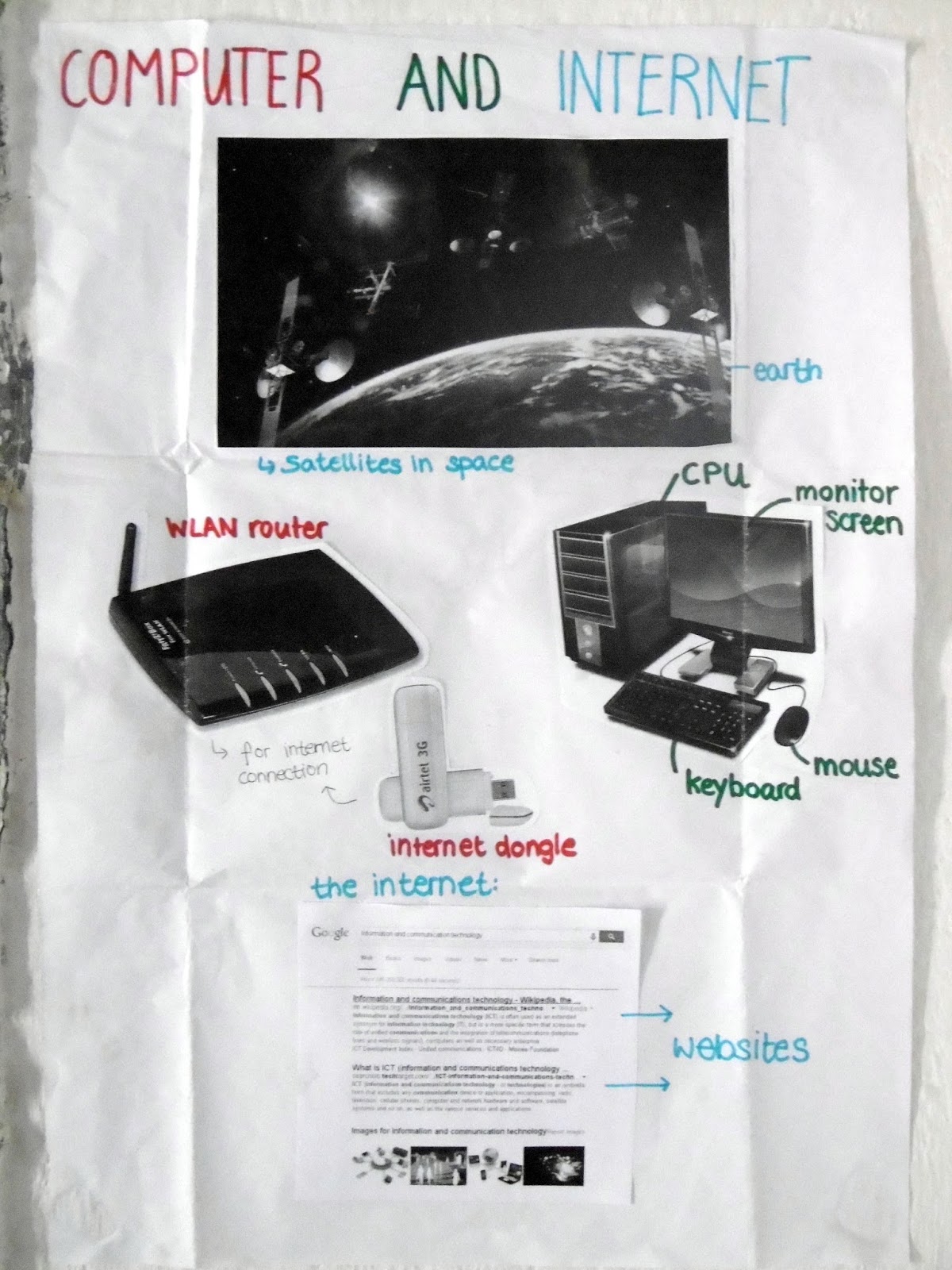
If we in Malawi want to phone someone in Germany… we connect through a satellite in space! A transmission tower in Blantyre sends radio waves into space. The satellite receives the radio waves and sends them on to Germany. Also in Germany there is a transmission tower that can receive radio waves.


3)      Computer


Input* devices
Keyboard (to enter information)
Mouse (controls cursor)
Camera
Microphone
Output* devices
Monitor/screen (shows what you are doing)
Printer (produces a printed copy)
Speaker
CPU
Central Processing Unit, the main part (heart=mtima) of the computer. A computer is a very clever technology. It can do mathematics much more difficult that you will ever do in school. All the skills of the computer come from the CPU.

*Input = to put information inside, to enter information
inside = mkati
output = to reveive information
outside = panja


4)      Internet

What is the internet?

The internet is a connection of many computers and mobile phones around the world. The information on the internet is arranged on websites. People use the internet to store and find information quickly.

How does the internet work?

  • The user enters information through the input devices of the computer
  • The CPU converts the information into digital language/digital signals
  • The digital signals are send to a satellite in space
  • The satellite in space sends the digital signals back to earth to the receiver/internet dongle
  • The CPU converts it into readable information
  • The user receives information through output devices

Revision

1) How do information and communication technologies connect?

I fix these charts on the board:


Questions for the learners:
How do phones connect?
  • Two fixed phone within Senga Bay (same local level)
  • Two fixed phones in different areas (Lilongwe to Senga Bay)
  • Mobile phones
  • A phone in Malawi to a phone in Germany
  • What are examples for telephone network providers?
How does the radio connect to the radio station?
How does the computer connect to the internet?
How does the television connect?

2) My tests:

Donnerstag, 16. Juli 2015

Nutrition and Meals

Context
SCIENCE/ Nutritional deficiency diseases
SCIENCE/ Healthy Nutrition
SCIENCE/ Meal planning and presentation
SCIENCE/ Packed meals

1) Nutritional deficiency diseases

What are nutritional deficiency diseases?
Diseases caused by a lack of a paticular nutrient in the diet.
Especially children are affected.

What are examples for nutritional deficiency diseases?
  • Aenemia
  • Kwashiorkor
  • Marasmus
What are the causes of kwashiorkor?
  • Lack of protein food in the diet, especially when the mother stops breastfeeding
  • Can also happen as consequence of a heavy infection such as malaria, diarrhoea, measles, tuberculose and intestinal worms

Worksheet 1 “Symptoms”


What is wrong with this children? What happened to them?
Malnutrition. They suffer a lack of a paticular nutrient in the diet.
The first baby is sick with kwashiorkor. The second baby suffers from marasmus.

We note down the symptoms next to the picture:

1)      Kwashiorkor: lack of protein food

  • Oedema (swelling because of accumulation of water)
  • Big tummy (because of enlarged liver)
  • poor appetite
  • diarrhoea and vomiting
  • loss of weight
  • failure to grow
  • skin peels off
  • hair looks thin and straight
  • mental retardation (no proper development of brain)

2)      Marasmus: lack of any kind of food

  • Good appetite
  • Thin
  • Little development of muscles
  • Wrinkled skin
  • Failure to grow
  • Looking alert (=bright/alarmed)

Prevention

  • Giving the child enough food
  • Giving the child enough protein food (milk)
  • Balanced diet
  • De-worming children regularly

Worksheet 2: “Sample story in Malawi”


2) Healthy Nutrition

Worksheet 3: “Right nutrition pyramid”


Explain on the sheet:
  • This are the 7 food groups (List examples for each food group.)
  • We should have a lot of the food groups from the bottom – beverages (mainly water), fruits and vegetables, grain food
  • We should only have small amounts of the food groups at the top of the pyramid – fats and sweets
  • All food groups have to be included in our diet! (Only not in same amounts)
  • If we follow these instructions, we have a balanced diet.

What is a source of protein food?
  • Milk and dairy product
  • Meat, fish and eggs

What is a source of carbohydrates?
  • Grain food

How much beverages/water should we have per day?
  • At least 1,5 litres. (show 3 small 500ml bottles)


I found this on a wall in Dedza (Malawi).


Meal planning and presentation

1) What is a meal?

A meal is a set of dishes eaten together at a specific time:
Breakfast (meal eaten in the morning)
Lunch (meal eaten at noon)
Dinner/supper (meal eaten in the evening)

2) Our favourite meals

We write a list of our most cherished meals!
-         rice with boiled eggs and tomatoes, onions, oil, salt
-         spaghetti with tomato-sauce
-         maccaroni with Soya Pieces and beef spice
-         sweet potatoes with groundnut-flour, salt
-         fried Irish potatoes (chips) with eggs, mayonese, cabbage salad
-         potato-salad with onions, green pepper, oil (vinegar)
-         nsima with rape and tomatoes
-         tea and mandazi
-         tea and popcorn
-         African cake (made of maize flour, ufa gaiwa) with Sobo
-         Boiled pumpkins
-         Banana-mango-fruit sala
-         Sobo with scones
-         Mphonda
-         Cassava and tea with milk

3) Menu of the week

  • I distribute white DinA4 Papers, which the learners cut and fold to small booklets.
  • We write “MENU OF THE WEEK” on the front page.
  • On the top of each of the following pages we write one day of the week: MONDAY, TUESDAY, WEDNESDAY, THURSDAY, FRIDAY.
  • Task for the learners: Write a menu for each day with your favourites meals! You need to plan a breakfast meal, a lunch, and a supper. Don´t forget to include a beverage for each meal. Include many food groups. On Sunday, think of something especially nice!


Example

BREAKFAST
Tea with milk (powder) and mandazi

LUNCH
Nsima with usipa, oil, onions and tomatoes
Clean drinking water
Desert: mango

DINNER
Sweet potatoes
Tea


Packed meals

The learners bring self-prepared packed meals into class.


1) I emphazise on the advantages of packed meals:


- packed meals are much more nutritious than the sweets that they buy in the tuckshop. Also it is cheaper.
- It helps them against the hunger when they are in class. It´s much easier to concentrate when one is not hungry.


2) We look at each of the packed meals and give "marks" for any fulfilled factor:


- the food is not spoiled when transported
- the food must be easy to eat using one´s hand
- the food includes many different food groups
- the food gives enough energy
- the packed meal includes a drink

Packed meals that my learners brought:
- boiled maize
- roasted maize
- boiled irish potatoes with tomatoes and onions
- fried eggs
- popcorn

other suggestions:
- mandazi
- bread/ scones
- fruit (bananas, mangos, guavas)
- boiled/roasted sweet potatoes
- boiled/roasted cassava


3) I bake small bread buns for my learners


Each bun has the size of a pingpong ball.

Ingredients for 30 buns (Cost 325 Malawian kwacha = less than 1 €)
1/2 kg bread flour
2 eggs
yeast
salt

4) I bring plastic bottles in class

  • We had many empty 250ml bottles in the house so I brought them to school. Now I know that it would have been better to give the learners the bottle with a condition (especially a good tip when you don´t have enough bottles for everyone): First they have to do a kind of homework.
  • But anyway, I emphasized again on the importance of drinking a lot of water during the day (3 or 4 of these bottles!) and made them promise to bring the bottles every day to school, filled with water. They were allowed to drink from this bottles in class, but not to go out anymore to drink from the well, like they had done before.
  • I have to admit that after some weeks I wasn´t very strict with that rules. But still, some of the learners brought their water bottles to class each and every day, up to the final closing day of the school!